Thematic Sessions
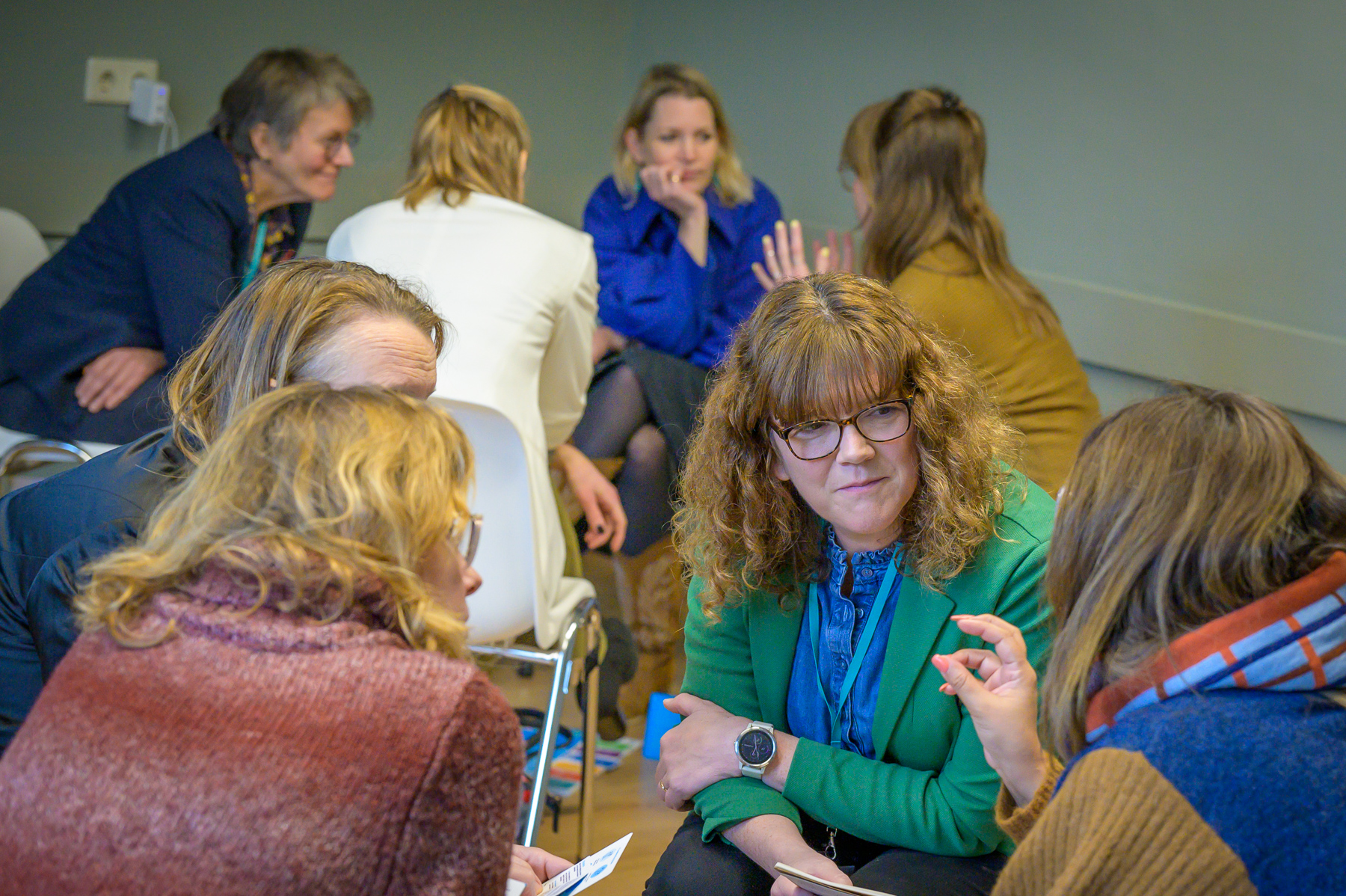
Thematic sessions
During the inspiration market, from 13:00 to 15:00, you can dive deeper into current issues during one of three thematic sessions. Each session offers an opportunity to explore a specific topic, hear different perspectives and exchange experiences and ideas with others.
Each thematic session lasts 40 minutes, leaving plenty of time to explore the inspiration market and visit the showcases before and after your session.
Please select one thematic session when completing your registration.
Discover the three thematic sessions and speakers below.
1. Catalyzing Recognition & Rewards at different evaluation levels
The so-called ‘Strategy Evaluation Protocol’ (SEP for friends) is a unique Dutch approach to research evaluation at the level of research institutes. It prescribes how universities periodically have to evaluate themselves in their own context.
In this interactive session three experienced evaluators unpack the workings of the SEP in the light of Recognition & Rewards. The underlying principles and evaluation criteria of the Strategy Evaluation Protocol have evolved significantly over the years, at the same time reflecting the transition to new forms of research evaluation, as well as supporting that very transition.
In dialogue with the audience, it is explored how institutional research evaluation interacts with the evaluation of individual researchers. There are obvious synergies, but many tensions exist as well. The audience is invited to critically reflect on the goals of different forms of research evaluation and their alignment. Far from a rigid, uniform rulebook, the Strategy Evaluation Protocol allows for meaningful and contextualized quality evaluation, catalyzing the Recognition & Rewards transition.
Rinze Benedictus was trained a biologist, and after working as a science journalist, is now active in science policy and management. He works as a staff advisor at the University Medical Center Utrecht and he has been involved in Recognition & Rewards from the very start. At UMC Utrecht he develops and implements new forms of research evaluation at different levels.
As external, parttime PhD candidate at CWTS, Leiden University, he investigates how the excellence concept of research quality became institutionalized in Dutch academic health research and how that interacted with the construction of university medical centers.
Thecla van Wageningen is a strategic policy advisor for the NWO institutes (NWO-I). Her main focus is academic culture encompassing recognition and rewards, scientific integrity and knowledge security.
After 25 years working at universities in roles as a researcher, educational innovator and manager, Darco Jansen has, since 2012, been strengthening the position of universities within national and international associations. He's been with UNL since 2019, initially focusing on Open Access and Open Science, but in recent years also on quality assurance (SEP), European legislation and regulations, public values and digital sovereignty.
2. PhD of the Future
At the core of every PhD trajectory is academic research. However, in practice PhD candidates do much more–they are involved in education, supervision, outreach, policy advice, setting up networks with societal partners, and maintaining Open-Science infrastructures, to mention just a few examples. Many of these activities appear high on the strategic agendas of universities, but they are rarely officially recognised and rewarded within the PhD trajectory. The PhD of the Future is a movement started by PromovendinetwerkNederland (PNN), Nationaal Expertisecentrum Wetenschap & Samenleving (NEWS), and De Jonge Akademie to open our minds for new ways of organising and evaluating PhD trajectories. In this session we discuss with everyone present what the different obstacles, opportunities, and perspectives are for the PhD of the Future.
Sicco de Knegt is the director of NEWS. Prior to this, his roles included head of research policy at Leiden University and programme coordinator for Open Science and Recognition & Rewards at Utrecht University. From 2016 to 2020, Sicco was editor-in-chief of the higher education and science website ScienceGuide, and before that he conducted neuroscience research at the Universiteit van Amsterdam.
Karin van Vuuren serves on the board of Promovendi Netwerk Nederland (PNN), with a portfolio focused on research policy. She is furthermore a PhD candidate at the Erasmus School of Health Policy and Management (ESHPM), Erasmus University Rotterdam, where her research examines the resilience of the health system related to crises.
Max van Duijn is chair of The Young Academy, part of the Royal Netherlands Academy of Arts and Sciences (KNAW), and PI of the SIM lab at the Leiden University Institute of Advanced Computer Science (LIACS). Research in his lab asks how social intelligence develops in humans and machines, and how this relates tolanguage and storytelling.
3. From policy to practice: what drives change in university teaching culture?
Changing policies and career frameworks is only one part of strengthening the recognition and reward of university teaching. The success of these reforms ultimately rests on how they are experienced by theacademic community. Drawing on findings from three waves of the Teaching Cultures Survey, this session willexplore some of the key drivers of cultural change and the factors that appear to shape academics’ experiences of how university teaching is valued and rewarded. It will also look ahead to a new global studythat goes behind the survey data to explore the institutional strategies, conditions and academic experiences that underpin positive change in practice.
Dr Ruth Graham is a higher education consultant whose work focuses on fostering change in higher education and strengthening university teaching and learning worldwide. A major strand of her work over the past decade has been Advancing Teaching, a global collaboration of university leaders and pedagogical experts working to improve the reward and recognition of university teaching. Her work through Advancing Teaching includes the development of the Career Framework for University Teaching, the Teaching Cultures Survey and the 2025 study mapping the global movement for change to the reward of university teaching.
Recognition & Rewards Festival
 Registration website for Recognition & Rewards Festival
Recognition & Rewards Festivalnienke@nekzt.nl
Recognition & Rewards Festivalnienke@nekzt.nlhttps://www.aanmelder.nl/recognitionandrewards
2026-11-12
2026-11-12
OfflineEventAttendanceMode
EventScheduled
Recognition & Rewards FestivalRecognition & Rewards Festival0.00EUROnlineOnly2019-01-01T00:00:00Z
To be announcedTo be announced