What is Multi-Entity Event Management?
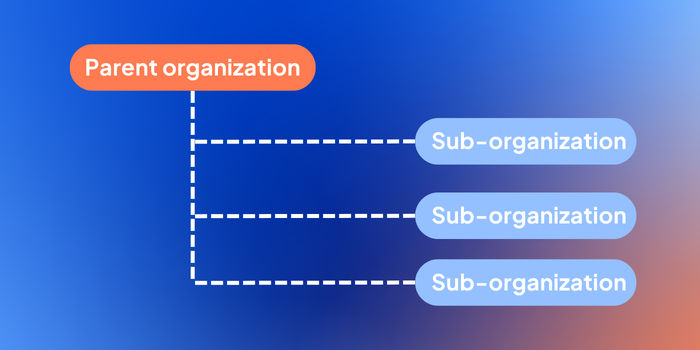
It’s actually quite simple: Multi-Entity Event Management is a way to manage events for different parts of a large organization from one central platform. Think of a holding company with various subsidiaries or a university with different faculties. Instead of signing a separate agreement for every entity, you sign one overarching agreement that all underlying parties can use. We refer to this as the parent and sub-organization structure.
This model is specifically designed for organizations seeking a balance between central control and local autonomy. After all, you want to benefit from economies of scale and uniform reporting while giving local teams the space to create their own success. It is the solution for organizations looking to move from "standalone accounts" to an overarching, professional, and scalable event process.
Another term you might come across is the "hub-and-spoke" model. You can visualize this like a bicycle wheel: there is one central hub with multiple metal spokes. The central hub represents the parent organization, and the spokes are the individual sub-organizations. Here too, logically structuring your event software and establishing a hierarchy is one of the starting points.
Tip: Looking to organize your event professionally and save time? Try aanmelder.nl’s software and sign up for a free 30-day trial. This way, you’ll experience firsthand what it’s like to be in the driver’s seat.
What are the benefits?
Multi-entity Event Management offers many different advantages. We’ve listed them for you:
-
Central procurement: Providers often offer economies of scale. By purchasing at the parent organization level instead of the sub-organization level, you likely receive volume discounts. This allows you to buy more cost-effectively.
-
Clear access policy: You can manage roles and permissions at the parent organization level. This ensures the right people get access to the right organizations or events—and that they cannot view activities or data not intended for them.
-
Fewer administrative tasks: aanmelder.nl links this to a team functionality. Place an employee in a sub-organization team, and they immediately gain access to all events within that entity. This not only keeps your system organized but also eliminates the administrative overhead of manually managing access, saving you from adding or removing users for every individual event
-
Insights at every level: At the main level, management can see total event numbers, registrants, and revenue. Meanwhile, team members can access specific data for their own department.
What does this look like in aanmelder.nl?
At aanmelder.nl, we work with the "Parent-Child" principle. A parent organization can have various sub-organizations. Within the parent organization, you set the framework, such as the overarching budget, who has access to which data, and what information you want to collect. Meanwhile, the sub-organizations or entities have the freedom to organize their own events independently. Inside aanmelder.nl, enterprise organizations can use this feature, also known as the "sub-organization" feature. By linking the "teams" functionality, you can grant a team access to a specific sub-organization. Think of a marketing department that only gets access to marketing events, or an IT department that accesses all events to streamline processes.
Our tips:
Every functionality has its benefits and risks. Based on our experience, we’ve listed the most important tips for you:
-
Avoid "over-engineering": Check if this option is truly relevant for your organization. Generally, we recommend it only becomes interesting when you have at least 5 events per sub-organization. Otherwise, you’ll likely end up with more administrative burden rather than less.
-
Appoint an Application Owner: At aanmelder.nl, both the parent organization owner and the application owner can create sub-organizations. We recommend appointing one central person responsible for managing access. This ensures your processes run smoothly.
-
Think in teams: Which team needs access to which sub-organization?. This makes setting up your system much easier. For example, it’s more efficient to grant the IT/application team access to all sub-organizations at once rather than adding an IT manager to each sub-team individually.
-
Set mandatory data fields: Every sub-organization quickly develops its own approach. By making certain data fields mandatory from the main organization, you ensure you collect the right data to compare "apples to apples".
Conclusion